Friday, December 9, 2016

Modeling

New freehand curve drawing tool uses curve fitting for bezier curves, with error and corner angle options, support for tablet pressure, drawing aligned or perpendicular to a surface, tapering, redo operator and calling from Python.
But wait, there’s more!
  • Edit-mode undo memory optimizations, allowing around 5X-15X memory savings
  • New N-Gons support for decimate modifier with double precision optimizations
  • New decimate edit-mode tool and dissolve tool to remove vertices re-fitting surrounding handles
  • Path select can now also select regions using the Fill Region option
  • New “Snap Selection to Active” option
  • New options for bevel modal operations, to change the profile (bevel shape) or number of segments, with mouse movements or numeric input to set the value

Cycles Render Engine

  • Optimizations: Several memory savings & speedups, support for CPU groups
  • GPU rendering: support for GTX NVIDIA 10×0, improved support for GTX 980 Ti and Titan X, memory improvements for CUDA & OpenCL
  • Better Subdivision & Micro Displacement experimental feature improved
  • Smoke volume support for Velocity and Heat attributes
  • Fluid simulation mesh support for motion blur and motion vectors
  • Point Density textures now support vertex color, weight and normals

Current Blender Version

The Blender Foundation and online developer community are proud to present Blender 2.78a, released September 30th 2016! This release aims to be a very stable one, so that developers can focus better on Blender 2.8 work. Here are some of the highlights:
  • Spherical Stereo images rendering support for VR
  • Grease Pencil is now a full 2D drawing & animation tool!
  • Viewport Rendering improvements
  • New Freehand curves drawing over surfaces!
  • Bendy Bones, powerful new options for B-Bones
  • Alembic support: import/export basic operators
  • Cloth Physics: new Dynamic Base Mesh and Simulation Speed option
  • New Add-ons, individual preferences, Python APIs changes, and a lot of new & updated add-ons!
  • Many more features, improvements and the usual huge bug-fixes list
The update Blender 2.78a was released on October 26, 2016. That release has 69 important bug fixes.

Blender Commercial

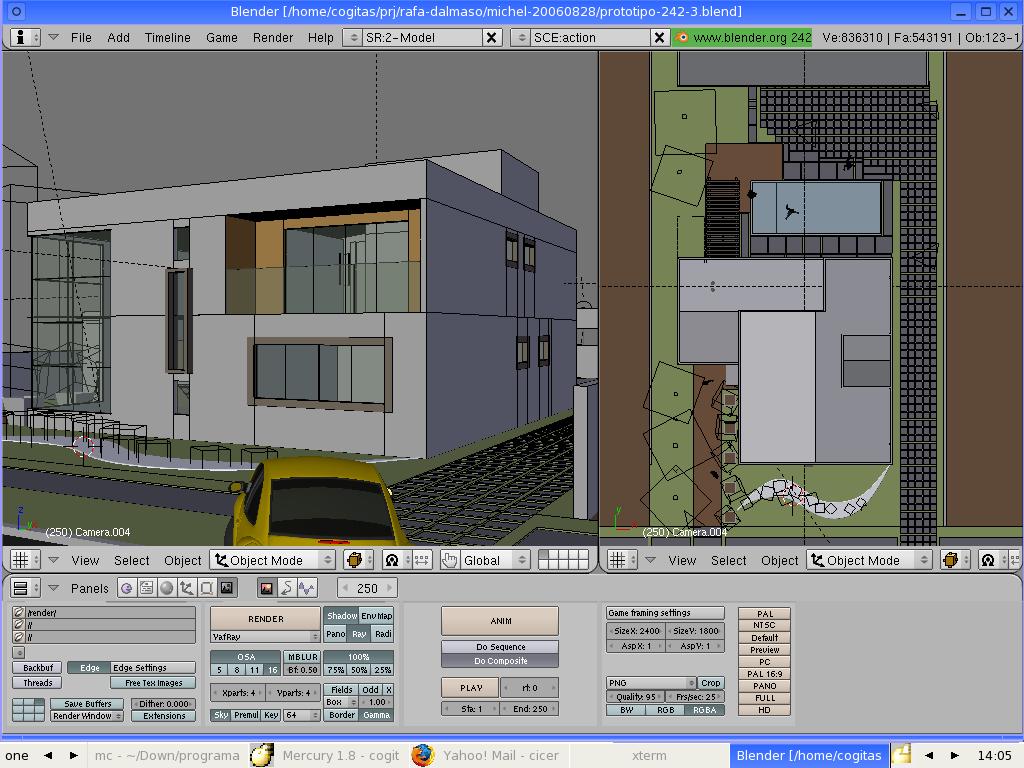
Cicero Moraes is a freelance modeler/animator from Mato Grosso, Brasil and he has recently created a series of TV commercials for a local petroleum company. One commercial, the Desemrenho, stands out to me because of how it showcases Blender fluids.

The 3D parts of the commercials were made with Blender and the post production was done by in Adobe After Effects by the studio, Nova Mídia Produções. Cicero says the studio has recently switched from 3DS Max to Blender and personally he only uses Linux and open source software for his productions.
Cicero likes Blender because it teaches people how to use the primitive 3D forms in correct way (only three or four sides), it is a powerful program that fits on less than 11MB and it is in constant development.screen4.jpg Like a lot of Blender users, he is self taught "I never went to an art school or computing design class. I learned all that I use (Blender, Gimp, Perl, Linux etc) alone. The community helped me in ways that I needed. The internet is a very powerful knowledge tool."
For more about Cicero visit his web site (English translation via Google) where you can browse through his many wonderful architectural renderings as well as his traditional drawings and animaitons.

Blender Cloud

The Blender Cloud platform, launched in March 2014 and operated by the Blender Institute, is a subscription-based cloud computing platform and Blender client add-on which provides hosting and synchronization for backed-up animation project files.[88] It was launched to promote and fundraise for Project: Gooseberry, and is intended to replace the selling of DVDs by the Blender Foundation with a subscription-based model for file hosting, asset sharing and collaboration.[89][90] A feature of the Blender Cloud is Blender Sync, which provides synchronization between Blender clients for file changes, user preferences and other features.[91]

Use in Media Industry

Blender started out as an inhouse tool for a Dutch commercial animation company NeoGeo.[47] Blender has been used for television commercials in several parts of the world including Australia,[48] Iceland,[49] Brazil,[50][51] Russia[52] and Sweden.[53]
Blender is used by NASA for publicly available 3D models. Many 3D models on NASAs 3D resources page are in a native .blend format.[54]
NASA also used Blender and Blend4Web to develop an interactive web application to celebrate the 3rd anniversary of the Curiosity rover landing on Mars.[55] This app[56] makes it possible to operate the rover, control its cameras and the robotic arm and reproduces some of the prominent events of the Mars Science Laboratory mission.[57][58] The application was presented at the beginning of the WebGL section on SIGGRAPH 2015.[59]
The first large professional project that used Blender was Spider-Man 2, where it was primarily used to create animatics and pre-visualizations for the storyboard department.
As an animatic artist working in the storyboard department of Spider-Man 2, I used Blender's 3D modeling and character animation tools to enhance the storyboards, re-creating sets and props, and putting into motion action and camera moves in 3D space to help make Sam Raimi's vision as clear to other departments as possible.[60] – Anthony Zierhut,[61] Animatic Artist, Los Angeles.
The French-language film Friday or Another Day (Vendredi ou un autre jour) was the first 35 mm feature film to use Blender for all the special effects, made on Linux workstations.[62] It won a prize at the Locarno International Film Festival. The special effects were by Digital Graphics[63] of Belgium.
Blender has also been used for shows on the History Channel, alongside many other professional 3D graphics programs.[64]
Tomm Moore's The Secret of Kells, which was partly produced in Blender by the Belgian studio Digital Graphics, has been nominated for an Oscar in the category "Best Animated Feature Film".[65]
Plumíferos, a commercial animated feature film created entirely in Blender,[66] was premiered in February 2010 in Argentina. Its main characters are anthropomorphic talking animals.
Special effects for episode 6 of Red Dwarf season X were confirmed being created using Blender by half of Gecko Animation, Ben Simonds. The company responsible for the special effects, Gecko Animation, uses Blender for multiple projects, including Red Dwarf.[67] The episode screened in 2012.[68][69]
Blender was used for both CGI and compositing for the movie Hardcore Henry.[70]

Integrator

The integrator is the rendering algorithm used for lighting computations. Cycles currently supports a path tracing integrator with direct light sampling. It works well for various lighting setups, but is not as suitable for caustics and some other complex lighting situations. Rays are traced from the camera into the scene, bouncing around until they find a light source such as a lamp, an object emitting light, or the world background. To find lamps and surfaces emitting light, both indirect light sampling (letting the ray follow the surface BSDF) and direct light sampling (picking a light source and tracing a ray towards it) are used.[34]
There are two types of integrators:
  1. The default path tracing integrator is a pure path tracer. At each hit it bounces light in one direction and picks one light to receive lighting from. This makes each individual sample faster to compute, but typically requires more samples to clean up the noise.
  2. The alternative is a branched path tracing integrator which at the first hit splits the path for different surface components and takes all lights into account for shading instead of just one. This makes each sample slower, but reduces noise, especially in scenes dominated by direct or one-bounce lighting.

File Format

Blender features an internal file system that can pack multiple scenes into a single file (called a ".blend" file).
  • All of Blender's ".blend" files are forward, backward, and cross-platform compatible with other versions of Blender, with the following exceptions:
    • Loading animations stored in post-2.5 files in Blender pre-2.5. This is due to the reworked animation subsystem introduced in Blender 2.5 being inherently incompatible with older versions.
    • Loading meshes stored in post 2.63. This is due to the introduction of BMesh, a more versatile mesh format.
  • All scenes, objects, materials, textures, sounds, images, post-production effects for an entire animation can be stored in a single ".blend" file. Data loaded from external sources, such as images and sounds, can also be stored externally and referenced through either an absolute or relative pathname. Likewise, ".blend" files themselves can also be used as libraries of Blender assets.
  • Interface configurations are retained in the ".blend" files.
A wide variety of import/export scripts that extend Blender capabilities (accessing the object data via an internal API) make it possible to inter-operate with other 3D tools.
Blender organizes data as various kinds of "data blocks", such as Objects, Meshes, Lamps, Scenes, Materials, Images and so on. An object in Blender consists of multiple data blocks – for example, what the user would describe as a polygon mesh consists of at least an Object and a Mesh data block, and usually also a Material and many more, linked together. This allows various data blocks to refer to each other. There may be, for example, multiple Objects that refer to the same Mesh, and making subsequent editing of the shared mesh result in shape changes in all Objects using this Mesh. Objects, meshes, materials, textures etc. can also be linked to from other .blend files, which is what allows the use of .blend files as reusable resource libraries.

UI

Editing modes
The two primary modes of work are Object Mode and Edit Mode, which are toggled with the Tab key. Object mode is used to manipulate individual objects as a unit, while Edit mode is used to manipulate the actual object data. For example, Object Mode can be used to move, scale, and rotate entire polygon meshes, and Edit Mode can be used to manipulate the individual vertices of a single mesh. There are also several other modes, such as Vertex Paint, Weight Paint, and Sculpt Mode.
Hotkey usage
Most of the commands are accessible via hotkeys. There are also comprehensive GUI menus.
Numeric input
Numeric buttons can be "dragged" to change their value directly without the need to aim at a particular widget, as well as being set using the keyboard. Both sliders and number buttons can be constrained to various step sizes with modifiers like the Ctrl and Shift keys. Python expressions can also be typed directly into number entry fields, allowing mathematical expressions to specify values.
Workspace management
The Blender GUI builds its own tiled windowing system on top of one or multiple windows provided by the underlying platform. One platform window (often sized to fill the screen) is divided into sections and subsections that can be of any type of Blender's views or window-types. The user can define multiple layouts of such Blender windows, called screens, and switch quickly between them by selecting from a menu or with keyboard shortcuts. Each window-type's own GUI elements can be controlled with the same tools that manipulate 3D view. For example, one can zoom in and out of GUI-buttons using similar controls one zooms in and out in the 3D viewport. The GUI viewport and screen layout is fully user-customizable. It is possible to set up the interface for specific tasks such as video editing or UV mapping or texturing by hiding features not used for the task.[28]

What is Blender?

Blender is a professional free and open-source 3D computer graphics software product used for creating animated films, visual effects, art, 3D printed models, interactive 3D applications and video games. Blender's features include 3D modeling, UV unwrapping, texturing, raster graphics editing, rigging and skinning, fluid and smoke simulation, particle simulation, soft body simulation, sculpting, animating, match moving, camera tracking, rendering, video editing and compositing. It further features an integrated game engine.